Quiz & Assessment Best Practices for Online Courses
Quizzes aren't busywork — they're one of the strongest levers for learning and completion. Here's how to use assessments well in your online course, from writing questions to handling cheating.
Quizzes get a bad rap as schooly busywork, but in an online course they're one of your most powerful tools. A well-placed quiz turns passive watching into active learning, shows students they're making progress, tells you exactly where people are confused, and gives a certificate real meaning. Assessment isn't an afterthought to bolt on at the end — used throughout, it's a core driver of whether students learn and finish.
This guide covers quiz and assessment best practices for online courses, India-first and practical: the types of assessment and when to use each, how to write questions that actually teach, how feedback turns a quiz into a learning moment, where to place assessments, the role of auto-grading, and an honest take on the cheating question. Get assessment right and your course both teaches better and completes better.
Why assessment matters more than you think
Assessment does several jobs at once, which is why skipping it costs you more than it seems.
- It makes learning active — retrieving an answer cements knowledge far better than passively watching, a well-established learning effect.
- It shows progress — each passed quiz is a small win that pulls learners onward, lifting completion.
- It reveals confusion — where learners fail tells you exactly which lessons to fix.
- It gives certificates meaning — an achievement certificate tied to passing an assessment is worth far more than one for mere completion.
- It builds confidence — getting answers right reassures learners they're actually learning.
Types of assessment — and when to use each
Assessment isn't only end-of-course exams. A range of formats, from light to deep, fits different moments.
- Quizzes (MCQs) — quick, auto-graded checks after a lesson or module; the workhorse for keeping learners engaged.
- Short-answer questions — test understanding in the learner's own words; harder to auto-grade but richer.
- Assignments — apply the skill to a task; ideal for practical courses.
- Projects — prove real ability by building something; the gold standard for skill courses and a great portfolio piece.
Use light, frequent quizzes throughout to maintain momentum and check understanding, and a deeper assignment or project (and a final assessment) where you need to confirm real capability — for instance, before awarding an achievement certificate.
How to write good quiz questions
A quiz is only as useful as its questions. Bad questions test memory of trivia or trick the learner; good questions test understanding of what matters and teach in the process.
- Test the key idea, not trivia — quiz what the lesson was actually about, not an obscure detail.
- Write clear, unambiguous questions — confusion should never come from the wording.
- Make wrong options plausible — distractors should reflect common mistakes, so the quiz reveals real misunderstanding.
- Avoid trick questions — the goal is learning, not catching people out.
- Keep difficulty fair — challenging enough to matter, achievable enough to encourage.
Feedback turns a quiz into a lesson
The most underused part of a quiz is the feedback after each answer. A quiz that just says 'wrong' is a missed teaching moment; a quiz that explains why an answer is wrong (and why the right one is right) turns every question into a mini-lesson. This is where a lot of the real learning happens — the learner discovers their misunderstanding and corrects it immediately, while it's fresh.
Wherever possible, attach a short explanation to each question, so a wrong answer becomes an 'aha' rather than just a mark lost. Good feedback also softens the sting of getting something wrong, keeping learners motivated rather than discouraged. The quiz stops being a test and becomes part of the teaching.
Where to place assessments
Placement shapes how much assessments help. A reliable rhythm: a short quiz after each module to check understanding and mark progress, optional practice questions within lessons for the keen, an assignment or project at a key milestone, and a final assessment before the certificate. This spreads the benefits — active recall, progress, confidence — across the whole course rather than dumping one big exam at the end.
Frequent, low-stakes quizzes are especially valuable in self-paced courses, where each one is a checkpoint that keeps a solo learner moving. Don't overdo it — assessment should support learning, not bury it — but a check every module is a good default.
Auto-grading: assess at scale
If you teach more than a handful of students, manual grading doesn't scale. Auto-graded quizzes (MCQs, true/false, fill-in-the-blank) mark themselves instantly, giving learners immediate feedback and saving you hours. On The Big Class, quizzes are auto-graded, so you can assess every learner after every module without it becoming a grading burden. Reserve your personal time for the deeper assignments and projects that genuinely need a human eye, and let auto-grading handle the frequent checks.
The honest take on cheating
Creators often worry that online quizzes are easy to cheat on — learners can look up answers. It's a fair point, and worth a clear-eyed response rather than an arms race. For most courses, the purpose of a quiz is learning, not policing: if a learner looks something up to answer, they've still engaged with the material, which is largely the point. Low-stakes quizzes don't need heavy anti-cheating measures.
Where assessment is high-stakes — tied to a meaningful achievement certificate — you can raise the bar with question banks and randomisation (so everyone sees a different set), time limits, and, most powerfully, assessment formats that are hard to fake: assignments and projects where the learner must produce real work. A project proves capability far better than an MCQ ever could, and it can't be Googled. Match your anti-cheating effort to the stakes, and don't let cheating fears stop you using quizzes for the learning benefits they bring.
Gamify assessment (lightly)
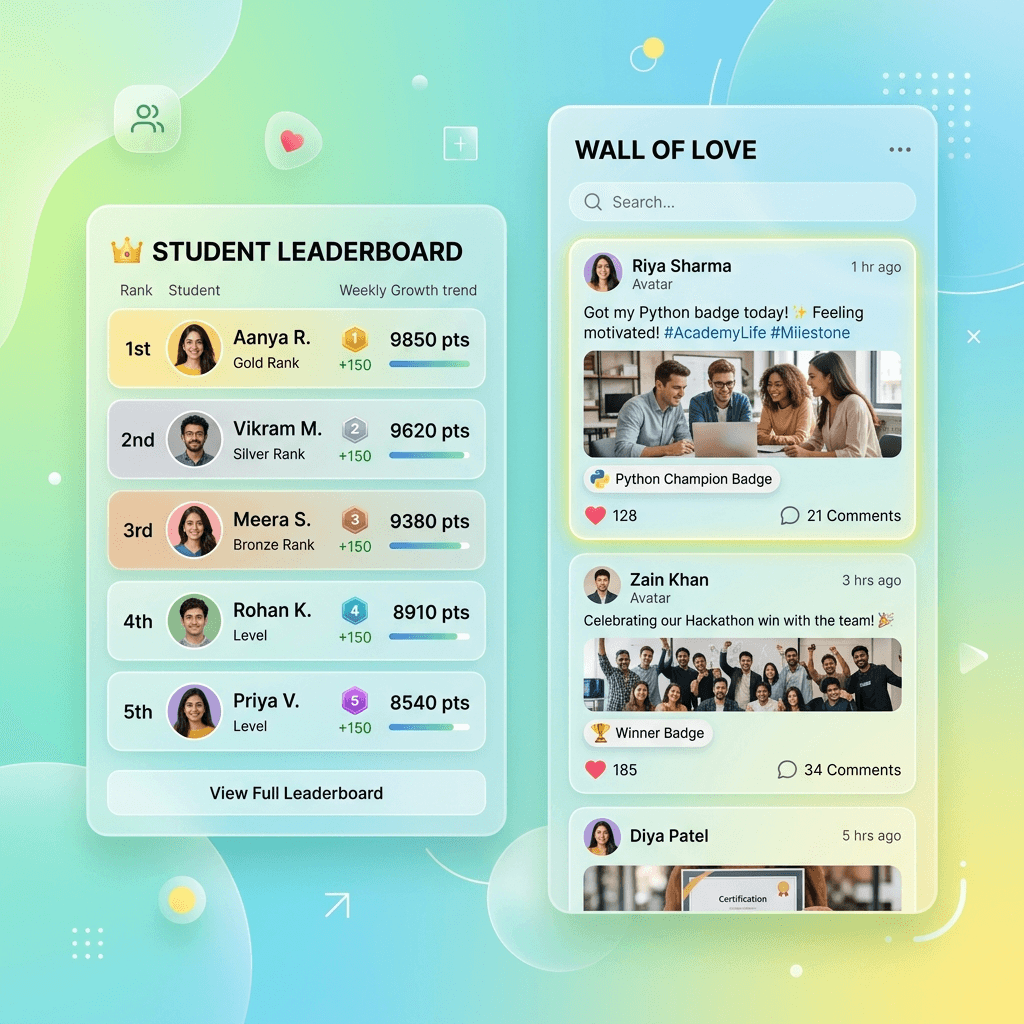
Assessment doesn't have to feel like an exam — a little game design makes it something learners enjoy and seek out. Points for passing a quiz, streaks for consistent practice, badges for milestones, and a leaderboard for the competitive turn checks into small rewards that pull learners back. Used lightly, gamification makes the next quiz feel like a challenge to beat rather than a hurdle to dread, which boosts both engagement and completion.
The key word is lightly. Gamification should encourage participation, not turn learning into a cynical grind or make slower learners feel bad. Tie rewards to effort and progress (showing up, improving, finishing) more than to raw scores, so the game motivates everyone rather than only the top performers. Done with a light touch, it makes assessment feel like part of the fun of learning, not a test imposed on it.
Use assessment data to improve your course
Your quizzes are quietly a feedback machine. When lots of learners get the same question wrong, that's not a learner problem — it's a signal that the lesson before it is unclear, too fast, or missing something. Watching which questions and which modules trip people up tells you precisely where to improve your course, far more reliably than guessing.
Treat assessment results as a map of confusion. If a particular concept consistently produces wrong answers, re-record or clarify that lesson, add an example, or insert a bridging lesson before it. Over time, this loop — assess, spot the weak point, fix it, re-assess — steadily raises both how much learners understand and how many of them finish. Assessment doesn't just measure learning; used this way, it improves your teaching.
Common assessment mistakes
- Skipping quizzes, leaving the course all passive watching.
- Only a single big exam at the end instead of checks throughout.
- Trick or trivia questions that frustrate instead of teach.
- No feedback on answers — wasting the biggest learning moment.
- Manual grading that doesn't scale (use auto-grading for checks).
- Over-engineering anti-cheating on low-stakes quizzes.
Your assessment checklist
- Add a short quiz after each module to keep learners active.
- Write clear questions that test the key idea, with plausible distractors.
- Attach an explanation to each answer so quizzes teach.
- Use assignments/projects at milestones for real capability.
- Auto-grade the frequent checks; reserve your time for deep work.
- Tie a final assessment to achievement certificates.
- Match anti-cheating effort to the stakes — projects for high stakes.
Assess every learner, automatically
Add auto-graded quizzes with feedback after every module, plus assignments and certificates — to lift learning and completion. On a free India-first platform with 0% commission.
See quizzes
Renu Rawat
Founder of thebigclass.com. Helping Indian educators and creators build profitable, independent learning businesses without losing 30% to platform fees.
About the founderFrequently asked questions
- Why should I add quizzes to my online course?
- Quizzes do several jobs at once: they make learning active (retrieving an answer cements knowledge far better than passive watching), show students progress (each passed quiz is a small win that lifts completion), reveal exactly where learners are confused so you can fix those lessons, build confidence, and give certificates real meaning when tied to passing an assessment. Far from busywork, well-placed quizzes are one of the strongest levers for both learning and completion in an online course.
- How do I write good quiz questions?
- Test the key idea of the lesson, not trivia or obscure details; write clear, unambiguous questions so confusion never comes from the wording; make wrong options plausible (reflecting common mistakes) so the quiz reveals real misunderstanding; avoid trick questions, since the goal is learning not catching people out; and keep difficulty fair — challenging enough to matter, achievable enough to encourage. And attach a short explanation to each answer so the quiz teaches, not just tests.
- Where should I put quizzes in my course?
- Use a rhythm rather than one big final exam: a short quiz after each module to check understanding and mark progress, optional practice questions within lessons for keen learners, an assignment or project at a key milestone, and a final assessment before the certificate. This spreads the benefits — active recall, progress, confidence — across the whole course. Frequent, low-stakes quizzes are especially valuable in self-paced courses, where each one is a checkpoint that keeps a solo learner moving.
- Aren't online quizzes easy to cheat on?
- They can be, but for most courses it matters less than feared, because the purpose of a quiz is learning, not policing — a learner who looks something up to answer has still engaged with the material. Low-stakes quizzes don't need heavy anti-cheating measures. Where assessment is high-stakes (tied to a meaningful certificate), raise the bar with question banks and randomisation, time limits, and especially assignments or projects that require real work and can't be Googled. Match anti-cheating effort to the stakes.
- What types of assessment work best for online courses?
- A range, from light to deep: auto-graded quizzes (MCQs, true/false) are the workhorse for quick, frequent checks; short-answer questions test understanding in the learner's words; assignments apply the skill to a task; and projects prove real capability and double as portfolio pieces. Use light, frequent quizzes throughout to maintain momentum and a deeper assignment or project (and a final assessment) where you need to confirm genuine ability, such as before awarding an achievement certificate.
- Should quiz answers include feedback?
- Yes — feedback is the most underused and valuable part of a quiz. A quiz that just says 'wrong' wastes a teaching moment, while one that explains why an answer is wrong and why the right one is right turns every question into a mini-lesson, with the correction landing while the material is fresh. Good feedback also softens the sting of a wrong answer, keeping learners motivated. Wherever possible, attach a short explanation to each question so the quiz becomes part of the teaching.
- How do I grade assessments without it taking forever?
- Use auto-grading for the frequent checks. Quizzes with objective formats (MCQs, true/false, fill-in-the-blank) mark themselves instantly, giving learners immediate feedback and saving you hours — so you can assess every learner after every module without a grading burden. Reserve your personal time for the deeper assignments and projects that genuinely need a human eye. On The Big Class, quizzes are auto-graded, which makes frequent assessment practical at any class size.
- Do assessments help students complete a course?
- Yes — assessments make learning active and visible, both of which drive completion. Each quiz turns passive watching into engagement, and each passed check is a small win that signals progress and pulls learners onward through the motivation dip in the middle. Assessments also reveal where learners get stuck so you can fix those lessons, and tying a final assessment to an achievement certificate gives learners a meaningful goal to finish for. Used throughout, assessment is a core driver of whether students learn and finish.
- Can I use assessment data to improve my course?
- Yes — your quizzes are quietly a feedback machine. When many learners get the same question wrong, it's usually not a learner problem but a signal that the lesson before it is unclear, too fast, or missing something. Watch which questions and modules trip people up, then re-record or clarify those lessons, add an example, or insert a bridging lesson. Over time this loop — assess, spot the weak point, fix it, re-assess — steadily raises both understanding and completion. Used this way, assessment doesn't just measure learning; it improves your teaching.
- Does gamifying quizzes actually help?
- Used lightly, yes — points, streaks, badges and a leaderboard turn checks into small rewards that pull learners back, making the next quiz feel like a challenge to beat rather than a hurdle to dread, which boosts engagement and completion. The key is restraint: tie rewards to effort and progress (showing up, improving, finishing) more than to raw scores, so the game motivates everyone rather than only top performers, and never let it turn learning into a cynical grind. Done with a light touch, gamification makes assessment feel like part of the fun of learning.
Keep reading

Online Course Completion Rates: How to Measure and Improve Them
Completion rate is the metric most creators never measure — and the one that quietly decides reviews, refunds and referrals. Here's what's good, how to measure it, and how to lift it.
Read
Certificates for Online Courses: Why They Matter and How to Do Them Right
A certificate is motivation, proof and marketing in one — if you do it right. Here's why certificates lift completion, what makes them credible, and how to issue verifiable ones at scale.
Read
How to Create an Online Course in India: A Step-by-Step Guide
From a blank page to a course people finish — validating the idea, structuring it well, recording on an Indian budget, and adding the quizzes and certificates that make it stick.
Read