How to Scale Your Coaching Business Online
You're booked out and your income is capped by your calendar. Here's how to scale a coaching business online — past 1:1, with leveraged models, systems, a team and recurring revenue.

There's a ceiling every successful coach eventually hits: you're fully booked, charging well, and still capped — because there are only so many hours in your week and your income is chained to them. Working harder isn't the answer; working differently is. Scaling a coaching business means breaking the link between your time and your income, so you can help more people and earn more without simply selling more hours of yourself.
This guide is for coaches who've already started and want to grow — not the basics of launching (that's how to start an online coaching business), but the leveraged models, systems, team and marketing that take you past the 1:1 ceiling. India-first and practical, it's about turning a coaching job into a coaching business that scales.
The ceiling: trading hours for money
Pure 1:1 coaching has a hard, mathematical limit. If you coach for, say, 25 hours a week at a given rate, your maximum income is fixed no matter how good you get — you can raise your rate, but you'll hit a price ceiling too. This is the trap: success makes you busier, not freer, until you're fully booked and still capped. Scaling is about escaping that maths by adding income that doesn't depend on your hours.
Lever 1 — Move from 1:1 to group and cohorts
The first and biggest leverage move is to coach more than one person at a time. A group programme or live cohort lets you serve five, twenty or fifty people in the same hour you'd have spent on one — multiplying your income per hour while each participant pays less than a 1:1 rate. Group coaching also adds peer energy and accountability that often improve outcomes, so it's not a compromise but frequently a better product.
You don't abandon 1:1 — keep it as a premium tier for those who want it, and add group/cohort offers beneath it. This single shift, from one-at-a-time to many-at-once, is where most coaches first break the ceiling.
Lever 2 — Productise into courses
The next leverage move is to package your repeatable teaching into self-paced courses that sell without your live time. Much of what you coach is the same foundational material taught again and again — turn that into a course and it sells while you sleep, freeing your live hours for higher-value work. Recording your cohort once gives you a self-paced product almost for free.
Courses scale infinitely — one course can serve a thousand learners as easily as ten — so they're how you add income that's fully decoupled from your hours. Use a self-paced course as an accessible entry offer that also feeds your higher tiers: someone buys the course, gets value, and upgrades to a cohort or 1:1.
Lever 3 — Add recurring revenue
Spiky, launch-to-launch income is stressful and hard to scale. A membership or community turns one-off coaching sales into predictable monthly revenue — members pay a recurring fee for ongoing access, community, regular group calls or continued support. A few hundred members at a monthly fee can become a serious, stable income that compounds as the base grows, with far less feast-or-famine than relying on launches alone. Recurring revenue is what makes a scaled coaching business financially solid.
Lever 4 — Build systems
You can't scale chaos. As you grow, the admin — payments, reminders, onboarding, scheduling, answering the same questions — multiplies and threatens to eat the time you just freed up. The fix is systems: automate everything that can be automated so the business runs without your constant attention.
- Automate payments and fees — UPI, EMI, recurring billing and reminders that collect without chasing.
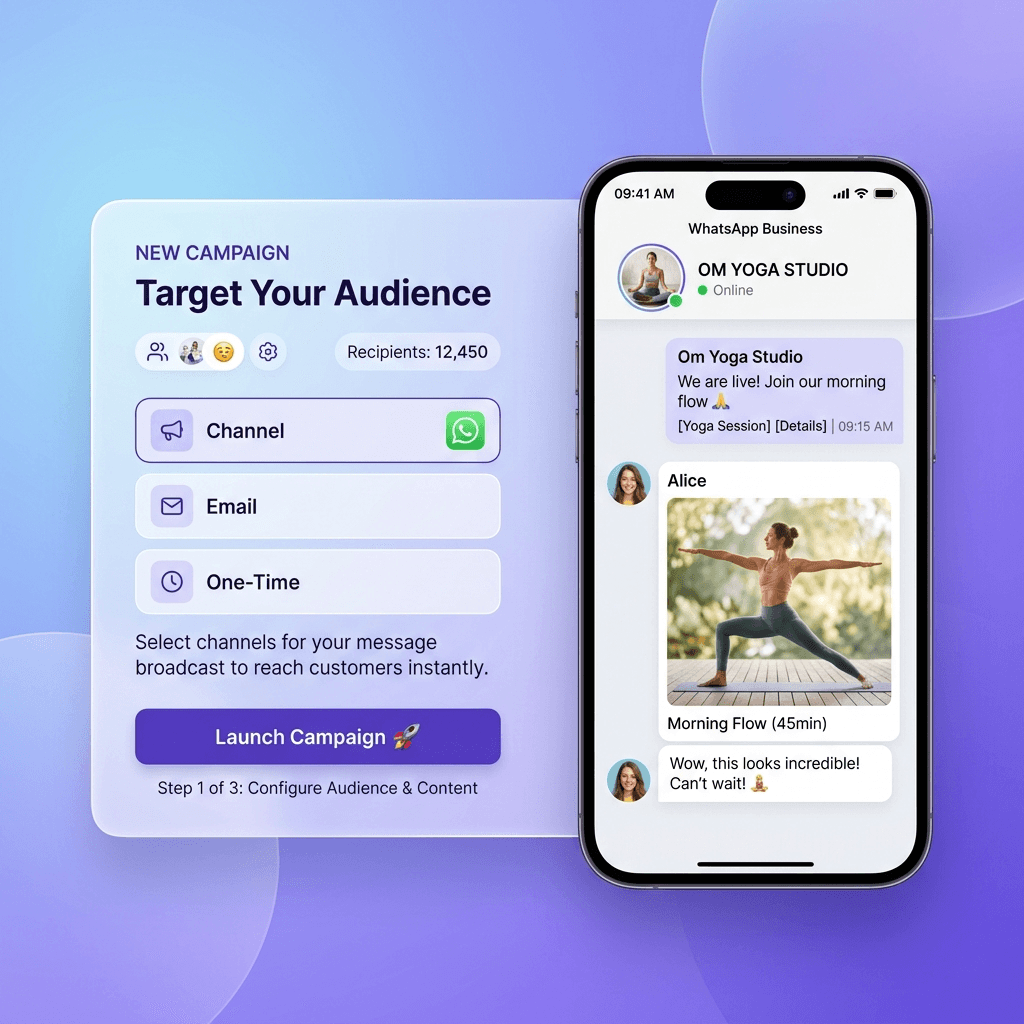
- Automate communication — welcome sequences, class reminders and nudges across in-app, email and WhatsApp.
- Automate onboarding — a self-serve start so new clients don't each need your hand-holding.
- Use one platform — running courses, live, payments and community in one place removes the glue work of stitching tools.
Systems are what let a scaled business stay sane. Every recurring task you automate is time returned to coaching and growing, rather than administering.
Lever 5 — Build a team
At some point, scaling means you stop being the only one who delivers. Bringing in co-coaches, teaching assistants or moderators lets you serve more students without personally teaching every hour — you design the programme and oversee quality while others help deliver. A community manager keeps engagement high; a TA handles doubts; a co-instructor takes modules you needn't teach yourself. A team multiplies your capacity beyond what even group coaching alone can, and is how coaching businesses grow into institutes.
Lever 6 — Scale your marketing
More capacity needs more students to fill it, so scaling delivery and scaling marketing go together. Move from finding clients one by one to building a marketing engine: consistent content that brings warm leads, an owned email/WhatsApp list you can launch to, free workshops that convert, and a referral flywheel from happy clients. As your delivery leverages up (cohorts, courses, membership), your marketing must keep the top of the funnel full — the two scale in tandem.
Protect what made you great
A word of caution: scaling can dilute the very quality that built your reputation if you're careless. As you move from 1:1 to groups, courses and a team, guard the outcomes and the personal touch that made clients rave. Use community and live touchpoints to keep scaled offers feeling personal, maintain quality as you delegate, and don't grow faster than you can deliver well. Scaling should multiply your impact, not water it down — sustainable growth keeps results strong as numbers rise.
Are you ready to scale?
Scaling too early is as much a mistake as scaling too late. Before you build cohorts, courses and a team, make sure the foundations are there — otherwise you're multiplying something that doesn't yet work. A few honest signs you're ready: your 1:1 coaching is consistently full or close to it, you have proof of results (testimonials, outcomes) to market with, and you understand your clients well enough to package what you do.
- You're booked out (or near it) — demand is bumping against your time, the classic signal to leverage.
- You have proof — results and testimonials that make a group offer or course credible.
- Your method is repeatable — you can see the common path your clients follow, ready to productise.
- You have (or can build) an audience — someone to fill the cohorts and courses you create.
If you're not there yet — still finding your first steady clients, still refining what works — focus on that first; scaling an unproven offer just multiplies the problems. But if those signs are present, staying in pure 1:1 is leaving growth (and income) on the table. The readiness check keeps you from scaling a leaky bucket.
Common scaling mistakes
- Staying in 1:1 forever out of comfort, capping your income.
- Scaling delivery without scaling marketing (empty cohorts).
- Growing without systems, drowning in admin.
- Trying to do everything yourself instead of building a team.
- Letting quality and the personal touch slip as you grow.
- Relying on spiky launches instead of adding recurring revenue.
Your coaching-scale checklist
- Move from 1:1 to group/cohort coaching (keep 1:1 as premium).
- Productise repeatable teaching into self-paced courses.
- Add a membership/community for recurring revenue.
- Automate payments, communication and onboarding.
- Build a team to deliver beyond your own hours.
- Scale marketing to keep cohorts and courses full.
- Protect outcomes and the personal touch as you grow.
Scale coaching without burning out
Run cohorts, sell courses, add a membership and automate the admin — all in one India-first platform with 0% commission. Build a coaching business that scales. Start free.
Start free
Renu Rawat
Founder of thebigclass.com. Helping Indian educators and creators build profitable, independent learning businesses without losing 30% to platform fees.
About the founderFrequently asked questions
- How do I scale my coaching business online?
- Break the link between your time and your income by moving up a leverage ladder: shift from 1:1 to group and cohort coaching (serving many per hour), productise repeatable teaching into self-paced courses that sell without your live time, add a membership or community for recurring revenue, automate payments, communication and onboarding so admin doesn't eat your gains, and build a team to deliver beyond your own hours. Scale your marketing in tandem to keep the new capacity full, and protect quality as you grow.
- How do I make more money coaching without working more hours?
- Stop selling only your time. Coach groups or cohorts instead of one-on-one (more income per hour, with peer energy that often improves results), package your repeatable teaching into self-paced courses that scale infinitely, and add a membership for recurring monthly revenue. Keep 1:1 as a premium tier rather than your whole business. These leveraged models add income that doesn't depend on your hours, which is the only way past the time-for-money ceiling.
- What's the first step to scaling a 1:1 coaching practice?
- Move from one-at-a-time to many-at-once with a group programme or live cohort. It's the biggest, simplest leverage step: you serve five, twenty or fifty people in the same hour you'd have spent on one, multiplying your income per hour while each participant pays less than a 1:1 rate — and the peer accountability often improves outcomes. Keep 1:1 as a premium tier for those who want it, and add group/cohort offers beneath it. This is where most coaches first break the ceiling.
- How do I add recurring revenue to my coaching business?
- Add a membership or paid community where clients pay a recurring monthly (or annual) fee for ongoing access, community, regular group calls or continued support. This turns spiky, launch-to-launch income into predictable revenue that compounds as your member base grows — a few hundred members at a monthly fee can become a serious, stable income with far less feast-or-famine. Recurring revenue is what makes a scaled coaching business financially solid and less stressful to run.
- Do I need a team to scale my coaching?
- Eventually, yes, if you want to grow beyond what even group coaching allows. Bringing in co-coaches, teaching assistants, moderators or a community manager lets you serve more students without personally teaching every hour — you design the programme and oversee quality while others help deliver doubts, engagement and modules you needn't teach yourself. A team multiplies your capacity and is how coaching businesses grow into institutes; start delegating the parts that don't need you specifically.
- How do I scale coaching without losing quality?
- Guard the outcomes and personal touch that built your reputation as you grow. Use community and live touchpoints to keep scaled offers (groups, cohorts, courses) feeling personal, maintain quality standards as you delegate to a team, and don't grow faster than you can deliver well. Scaling should multiply your impact, not dilute it — sustainable growth keeps results strong as numbers rise, which protects the referrals and reputation your business depends on.
- Should I keep doing 1:1 coaching as I scale?
- Yes, but reposition it. Rather than your whole business, keep 1:1 as a premium top tier for clients who want maximum access and are willing to pay for it, while group coaching, courses and a membership handle volume beneath it. This way you capture both high-paying clients who want personal attention and a larger audience served by leveraged offers — using the same expertise across every tier instead of being capped by your 1:1 calendar.
- How do I keep my cohorts and courses full as I scale?
- Scale your marketing alongside your delivery. Move from finding clients one at a time to building a marketing engine: consistent content that brings warm leads, an owned email and WhatsApp list you can launch to, free workshops that convert attendees into students, and a referral flywheel from happy clients. As your capacity grows with cohorts, courses and a membership, your marketing must keep the top of the funnel full — the two have to scale together, or you end up with empty cohorts.
- When am I ready to scale my coaching business?
- When the foundations are proven, not before — scaling too early just multiplies what doesn't work. Good signs you're ready: your 1:1 coaching is consistently full or near it (demand is bumping against your time), you have results and testimonials to market with, your method is repeatable enough to package, and you have or can build an audience to fill cohorts and courses. If you're still finding your first steady clients or refining what works, focus there first. But if those signs are present, staying in pure 1:1 leaves real growth and income on the table.
- How do I scale coaching without losing the quality that built it?
- Guard the outcomes and personal touch that made clients rave as you grow. Use community and live touchpoints to keep scaled offers (groups, cohorts, courses) feeling personal, maintain clear quality standards as you delegate to co-coaches or assistants, and don't grow faster than you can deliver well. Scaling should multiply your impact, not dilute it — sustainable growth keeps results strong as numbers rise, which protects the referrals and reputation your business depends on. If quality slips, the leverage isn't worth it; pace your growth to what you can deliver.
Keep reading
How to Start an Online Coaching Business in India (2026)
From your first paying client to a business that doesn't depend on your calendar — models, tools, pricing, getting students, and scaling your coaching without burning out.
Read
How to Build a Membership Site as an Educator in India
Course launches are spiky — feast then famine. A membership turns your expertise into predictable monthly income. Here's how to build one that members actually stay in.
ReadHow to Market an Online Course in India
Build it and they won't come — you have to market it. Here's the complete, India-first playbook to market an online course, from owning your audience to launches and referrals.
Read